coffeedent.org · Study Guide
FCPS Part 1 Dentistry: 4, 5 & 6-Month Preparation Plan
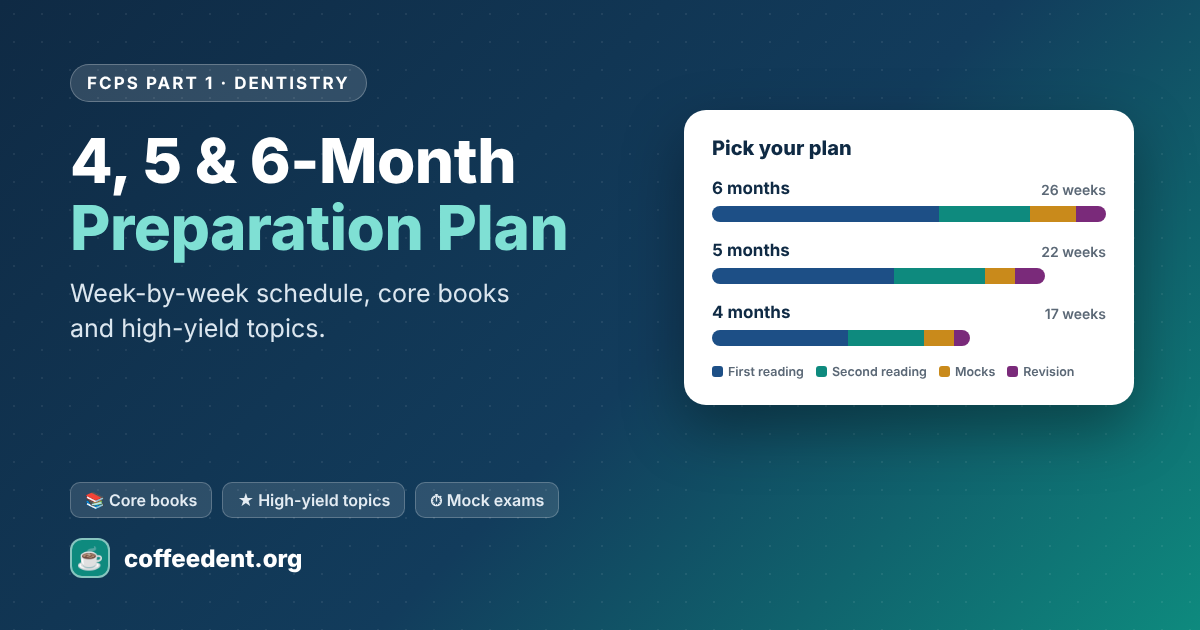
A week-by-week plan for FCPS Part 1 Dentistry: which subjects carry the most marks, which books to read, which topics matter most, and how to practise on coffeedent.org.
1How the exam is built
FCPS Part 1 Dentistry has 200 single-best-answer MCQs. About two-thirds test basic medical sciences, and the rest test dental sciences. Anatomy and pathology alone give almost 40 per cent of the questions.
Clinical, periodontal and community questions are rising fast
These three subjects made up about 11% of recent exams and about 35% of the October 2026 exam. Share of questions by subject.
2023–2026 exams October 2026 exam Biggest rises
Shares are approximate.
For many years anatomy, pathology and pharmacology led every exam. In October 2026, pharmacology, physiology and biochemistry fell sharply, while clinical scenarios on extraction, endodontics, dentures, orthodontics and ethics took their place. Plan your time in the same proportions, and give clinical subjects a real share of the plan, not just the last week.
2Books to read
Read one core book per subject, twice. Use reference books only to look up what the core book does not explain.
On a phone, swipe the table sideways to see all columns →
| Subject | Core book (read it) | Reference (look up only) | Focus while reading |
|---|---|---|---|
| Anatomy (head & neck, gross) | Snell’s Clinical Anatomy by Regions, 10th ed. | BD Chaurasia’s Human Anatomy Vol. 3, 9th ed. | Skull foramina, cranial nerves, neck triangles, infratemporal and pterygopalatine fossae, lymph drainage, muscles of mastication |
| Neuroanatomy | Snell’s Clinical Neuroanatomy, 8th ed. | — | Cranial nerve nuclei and lesions, cortical areas, cerebellum, blood supply of the brain |
| Embryology | Langman’s Medical Embryology, 14th ed. | — | Pharyngeal arches, pouches and clefts, face and palate, tongue, thyroid |
| General histology | Junqueira’s Basic Histology, 16th ed. | — | Epithelia, cartilage, bone, glands, lymphoid organs, nerve tissue |
| Oral biology & tooth morphology | Ten Cate’s Oral Histology, 9th ed. | Wheeler’s Dental Anatomy, Physiology and Occlusion, 11th ed. | Tooth development, enamel, dentin, pulp, cementum, PDL, eruption chronology, root canals, occlusion |
| Physiology | Guyton and Hall Textbook of Medical Physiology, 14th ed. | — | Nerve and muscle, CVS, respiration, renal and acid-base, GIT, endocrine, sensory system |
| Biochemistry | Lippincott Illustrated Reviews: Biochemistry, 8th ed. | Harper’s Illustrated Biochemistry, 31st ed. | Vitamins, lipoproteins, amino acids, enzymes, purine metabolism, molecular biology |
| General & systemic pathology | Robbins Basic Pathology, 11th ed. | Robbins and Cotran Pathologic Basis of Disease, 10th ed. | Cell injury, inflammation, repair, haemodynamics, immunopathology, neoplasia, blood, endocrine, liver |
| Microbiology & immunology | Levinson’s Review of Medical Microbiology and Immunology, 17th ed. | Jawetz, Melnick and Adelberg’s Medical Microbiology, 28th ed. | Hypersensitivity types, immunodeficiency, oral pathogens, HIV, HBV, HSV, EBV, sterilisation |
| Pharmacology | Katzung’s Basic and Clinical Pharmacology, 15th ed. | Lippincott Illustrated Reviews: Pharmacology, 8th ed. | Pharmacokinetics, ANS, local and general anaesthetics, antimicrobials, analgesics, CNS and endocrine drugs, antidotes |
| Dental materials | Phillips’ Science of Dental Materials, 13th ed. | Manappallil’s Basic Dental Materials, 5th ed. | Properties, gypsum, impression materials, amalgam, cements, composite, GIC, ceramics, alloys, casting, denture resins |
| Oral pathology, oral medicine & radiology | Neville’s Oral and Maxillofacial Pathology, 4th ed. | Shafer’s Textbook of Oral Pathology, 9th ed. | Developmental anomalies, cysts and tumours, white and red lesions, vesiculobullous disease, salivary and bone disease |
| Periodontology | Newman and Carranza’s Clinical Periodontology, 13th ed. | — | Gingiva, GCF, plaque, ANUG, periodontal abscess, syndromes, indices |
| Community dentistry & ethics | Soben Peter’s Essentials of Public Health Dentistry, 6th ed. | Park’s Textbook of Preventive and Social Medicine, 26th ed. | Fluorides, indices (DMFT, CPI, Dean’s), health education models, epidemiology, consent, ethics |
| Clinical dentistry | Hupp’s Contemporary Oral and Maxillofacial Surgery, 7th ed.; Malamed’s Handbook of Local Anesthesia, 7th ed. | Cohen’s Pathways of the Pulp, 12th ed.; Zarb’s Prosthodontic Treatment for Edentulous Patients, 13th ed.; Proffit’s Contemporary Orthodontics, 6th ed.; McDonald and Avery’s Dentistry for the Child and Adolescent, 10th ed.; Sturdevant’s Art and Science of Operative Dentistry, 7th ed. | Extraction complications, LA doses and toxicity, irrigants and pulp therapy, denture problems, tooth movement, behaviour management, restorative techniques |
| General medicine | Kumar and Clark’s Clinical Medicine, 10th ed. | — | Thyroid, diabetes, anaemias, jaundice, shock, medical emergencies in the dental chair |
3High-yield topics
These topics are tested again and again. Master them first.
Anatomy & embryology
Pharyngeal arches and pouches (thymus and inferior parathyroid from the 3rd pouch, malleus and incus from Meckel’s cartilage, stylopharyngeus from the 3rd arch); cranial nerve lesions (facial palsy, hypoglossal deviation, abducens in cavernous sinus, corneal reflex); taste pathways; pterygopalatine and otic ganglia; lymph drainage of lip and tongue; parotid duct; neck fascia and triangles; skull foramina; vertebral levels; muscles of mastication; joint and cartilage types.
Neuroanatomy
Broca’s and Wernicke’s areas, hippocampus and memory, cerebellar signs, glial cells, tractus solitarius, middle meningeal artery and extradural haematoma.
Physiology
Thyroid, growth hormone, ADH and insulin; ECG waves and heart sounds; lung volumes and types of hypoxia; central chemoreceptors; GFR and clearance (inulin, creatinine); acid-base disorders; GIT hormones; gate theory of pain; sensory receptors; local metabolites and blood flow.
Biochemistry
Lipoproteins (HDL, LDL, chylomicrons); vitamins A, B12, folate, K, C, D, thiamine and riboflavin; sulphur amino acids; purine metabolism and uric acid; iron storage; catecholamine synthesis (PNMT); enterokinase and lactase; antioxidants and free radicals.
General & systemic pathology
Cell injury and necrosis types; acute inflammation mediators (histamine, C3b); wound healing and myofibroblasts; hypersensitivity types I–IV; neoplasia, dysplasia and oncogenes; hypercalcaemia; anaemias; jaundice; portal hypertension; thyroid disease; radiosensitivity.
Microbiology & immunology
Tuberculin test; IgA deficiency and IgE; antibody classes; ANUG flora; HIV, EBV, HSV; actinomycosis; sterilisation and disinfection (glutaraldehyde).
Pharmacology
Local anaesthetics (mechanism, bupivacaine toxicity, maximum doses, paraben allergy); aspirin and paracetamol; antimicrobials, metronidazole with alcohol, endocarditis prophylaxis; anti-TB side effects; ketamine; opioid toxicity and pethidine with MAOIs; benzodiazepines; pharmacokinetics.
Dental materials
Amalgam phases (gamma-2), copper, creep and corrosion; alginate, PVS, polyether and elastomers; ZOE under composite, zinc phosphate mixing, GIC fluoride; composite shrinkage and layering; HF etching and zirconia; gold cold welding and onlays; metamerism and chroma; acrylic shrinkage and porosity; toughness and modulus.
Oral biology & tooth morphology
Stages of tooth development (gemination and fusion); enamel and dentin composition; cementum versus bone; eruption chronology including third molars; MB2 and C-shaped canals; mesiolingual groove of the mandibular first premolar; oblique ridge; filiform papillae.
Oral pathology & radiology
Dentinogenesis imperfecta, ectodermal dysplasia, OFD syndrome, Papillon-Lefèvre; hypercementosis and Paget’s disease; fibrous dysplasia; lichen planus, pemphigoid, erythema multiforme; oral submucous fibrosis; hairy leukoplakia; Turner’s hypoplasia; attrition and erosion; radiation caries; Burkitt lymphoma and multiple myeloma.
Periodontology
GCF, interdental papilla, ANUG, gingival and periodontal abscess, Russell’s index and CPI sextants, orthodontic bone remodelling.
Community dentistry & ethics
Fluoride toothpaste dosage, school programmes, Dean’s index, DMFT; Health Belief Model; consent for minors, gifts, transference, breaking bad news, confidentiality.
Clinical dentistry
Dry socket, hypochlorite accident, pulp capping and apexogenesis, internal bleaching, replacement resorption, denture complaints and psychological patients, Sunday bite, tell-show-do, socket healing timeline, high restorations.
4Study on coffeedent.org
All the practice in these plans is done on coffeedent.org, which has the FCPS Part 1 Dentistry past papers, subject-wise MCQs, notes and full-length mock exams in one place. Wherever a plan says “MCQs a day”, “past papers” or “mocks”, do them on coffeedent.org.
First reading
Notes and subject-wise MCQs for the chapter you read that day.
Second reading
Past papers by year, from Past to the most recent paper, with answers and explanations.
Mock exams
Full 200-MCQ timed mock exams under exam conditions.
Final weeks
Notes for quick revision, and re-solving the most recent papers.
Choose your plan
Pick the plan that matches the time left before your exam.
56-month plan
First reading Second reading / past papers Mock exams Revision
Full first reading of every subject, a second reading driven by past papers, and five weeks of mocks and revision.
On a phone, swipe the table sideways to see all columns →
| Weeks | Phase | Subjects and reading | MCQs/day | End-of-block target |
|---|---|---|---|---|
| 1–2 | First reading | Head and neck anatomy, skull and osteology | 60 | Draw cranial nerves and foramina from memory |
| 3 | First reading | Neuroanatomy; thorax and abdomen essentials | 60 | Localise any cranial nerve or cortical lesion |
| 4 | First reading | Embryology (arches, face, palate, tongue); general histology | 60 | Table of arch and pouch derivatives |
| 5 | First reading | Oral biology and tooth morphology | 60 | Eruption chronology and canal anatomy |
| 6–7 | First reading | Physiology: nerve, muscle, blood, CVS, respiration, renal, acid-base, GIT, endocrine | 70 | Solve any acid-base and hypoxia question |
| 8 | First reading | Biochemistry; immunology and microbiology | 70 | Vitamin and lipoprotein charts |
| 9–10 | First reading | General pathology, then systemic pathology and haematology | 70 | Hypersensitivity, necrosis and neoplasia charts |
| 11 | First reading | Pharmacology, including local and general anaesthetics | 70 | Side effects and antidotes list |
| 12–13 | First reading | Dental materials: properties to impression materials, then cements to alloys and ceramics | 70 | Amalgam phases and impression material table |
| 14 | First reading | Oral pathology, oral medicine and radiology | 70 | Syndromes and lesions list |
| 15 | First reading | Periodontology, community dentistry and ethics, clinical dentistry | 70 | Indices and fluoride doses list |
| 16 | Second reading | Anatomy and embryology (high-yield) + past papers 2010–2013 | 120 | Review every wrong answer |
| 17 | Second reading | Physiology and biochemistry + past papers 2014–2016 | 120 | Review every wrong answer |
| 18 | Second reading | Pathology, microbiology and immunology + past papers 2017–2019 | 120 | Review every wrong answer |
| 19 | Second reading | Pharmacology and general medicine + past papers 2020–2021 | 120 | Review every wrong answer |
| 20 | Second reading | Dental materials and oral biology + past papers 2022–2023 | 120 | Review every wrong answer |
| 21 | Second reading | Oral pathology, periodontology, community and clinical dentistry + past papers 2024–2026 | 120 | All past papers solved once |
| 22–24 | Mock exams | Two full 200-MCQ timed mocks a week; revise weak subjects between mocks | 200/mock | Score above 70% and rising |
| 25 | Revision | High-yield topics (section 3); your error notebook | 150 | Error notebook read twice |
| 26 | Final week | Light revision, one last mock early in the week, rest before the exam | 100 | Rested and confident |
65-month plan
First reading Second reading / past papers Mock exams Revision
Keeps a full first reading but merges smaller subjects and starts past papers one week earlier.
On a phone, swipe the table sideways to see all columns →
| Weeks | Phase | Subjects and reading | MCQs/day | End-of-block target |
|---|---|---|---|---|
| 1–2 | First reading | Head and neck anatomy, osteology, neuroanatomy | 70 | Cranial nerves, foramina and lesions |
| 3 | First reading | Embryology, general histology, oral biology and tooth morphology | 70 | Arch derivatives and eruption tables |
| 4–5 | First reading | Physiology (all systems) | 80 | Acid-base, hypoxia and endocrine control |
| 6 | First reading | Biochemistry; immunology and microbiology | 80 | Vitamins, lipoproteins, hypersensitivity |
| 7–8 | First reading | General and systemic pathology, haematology | 80 | Necrosis, inflammation, neoplasia, anaemias |
| 9 | First reading | Pharmacology, local and general anaesthetics | 80 | Side effects and antidotes list |
| 10–11 | First reading | Dental materials (all chapters) | 80 | Tables for impression materials, cements and alloys |
| 12 | First reading | Oral pathology and radiology; periodontology; community dentistry, ethics and clinical dentistry | 80 | Syndromes, indices and fluoride doses |
| 13 | Second reading | Anatomy, embryology, oral biology + past papers 2010–2014 | 130 | Review every wrong answer |
| 14 | Second reading | Physiology, biochemistry + past papers 2015–2018 | 130 | Review every wrong answer |
| 15 | Second reading | Pathology, microbiology, immunology + past papers 2019–2020 | 130 | Review every wrong answer |
| 16 | Second reading | Pharmacology, general medicine + past papers 2021–2022 | 130 | Review every wrong answer |
| 17 | Second reading | Dental materials + past papers 2023–2024 | 130 | Review every wrong answer |
| 18 | Second reading | Oral pathology, periodontology, community and clinical dentistry + past papers 2025–2026 | 130 | All past papers solved once |
| 19–20 | Mock exams | Two full 200-MCQ timed mocks a week; revise weak subjects between mocks | 200/mock | Score above 70% |
| 21 | Revision | High-yield topics (section 3); error notebook | 150 | Error notebook read twice |
| 22 | Final week | Light revision, one last mock early in the week, rest | 100 | Rested and confident |
74-month plan
First reading Second reading / past papers Mock exams Revision
Reads high-yield chapters only and learns the rest through MCQ practice on coffeedent.org.
On a phone, swipe the table sideways to see all columns →
| Weeks | Phase | Subjects and reading | MCQs/day | End-of-block target |
|---|---|---|---|---|
| 1–2 | Fast first reading | Head and neck anatomy, neuroanatomy, embryology (high-yield chapters) | 100 | Cranial nerves, foramina, arch derivatives |
| 3 | Fast first reading | Histology, oral biology, tooth morphology | 100 | Development and eruption tables |
| 4 | Fast first reading | Physiology (high-yield systems) | 100 | Acid-base, hypoxia, endocrine |
| 5 | Fast first reading | Biochemistry, immunology, microbiology | 100 | Vitamins, lipoproteins, hypersensitivity |
| 6 | Fast first reading | General and systemic pathology | 100 | Necrosis, inflammation, neoplasia |
| 7 | Fast first reading | Pharmacology and anaesthetics | 100 | Side effects and antidotes list |
| 8 | Fast first reading | Dental materials | 100 | Comparison tables |
| 9 | Fast first reading | Oral pathology, periodontology, community dentistry, ethics, clinical dentistry | 100 | Syndromes, indices, fluoride doses |
| 10–14 | Past papers | Solve every past paper in 5 weeks (about 16 papers a week, 2010 to 2026); read the book topic behind every wrong answer | 200 | Every paper solved, wrong answers reviewed |
| 15–16 | Mock exams | Three full 200-MCQ timed mocks a week; revise weak subjects between mocks | 200/mock | Score above 70% |
| 17 | Final week | High-yield topics, error notebook, rest before the exam | 150 | Rested and confident |
8Daily routine
Every study day has three parts: read, test, review. Reading without questions does not stick, and questions without review only repeat mistakes.
On a phone, swipe the table sideways to see all columns →
| Time block | 6-month | 5-month | 4-month | What to do |
|---|---|---|---|---|
| Morning | 3 h | 3.5 h | 4 h | Read the day’s chapter from the core book; make one-page summary charts |
| Afternoon | 2 h | 2.5 h | 3.5 h | Solve the same topic’s MCQs on coffeedent.org, untimed (Also check Eesha Notes) |
| Evening | 1 h | 1.5 h | 2 h | Review every wrong or guessed answer; read that exact page again; write it in your error notebook |
| Weekly | Sunday | Sunday | Sunday | Re-solve the week’s wrong answers and revise the week’s charts |
How to practise MCQs well
9Final 4 weeks and exam day
The last month is for testing and revision only. Start no new books and no new topics.
Final 4 weeks checklist
On exam day
Prepared by coffeedent.org
0 responses on "4. 5 and 6 Months Plan to Prepare for FCPS Part 1 Dentistry"